

Blog > My 2027 Denver Real Estate Market Prediction
Prices are flat and interest rates are climbing. Even so, Golden saw 16% appreciation year over year, while Castle Rock depreciated by close to 5%. So what is going on?
Denver Metro is a huge area made up of many cities and small local markets. I sit on the Market Trends Committee for the Denver Metro Association of Realtors (DMAR), and every month I talk with my colleagues about what is really happening in the market. Here is what happened in 2026, and the three factors I believe will shape 2027 for buyers and sellers.
Watch the video: https://www.youtube.com/watch?v=KcjhsctZl0g

Heather O'Leary is a contributing expert writer for DMAR's Market Trends Report. She wrote the analysis of homes sold between $500,000 and $749,999 in the October 2026 report.
What Happened in 2026: Seasonality Held
As of September, prices are up 5.5% year to date and 2.7% year over year.
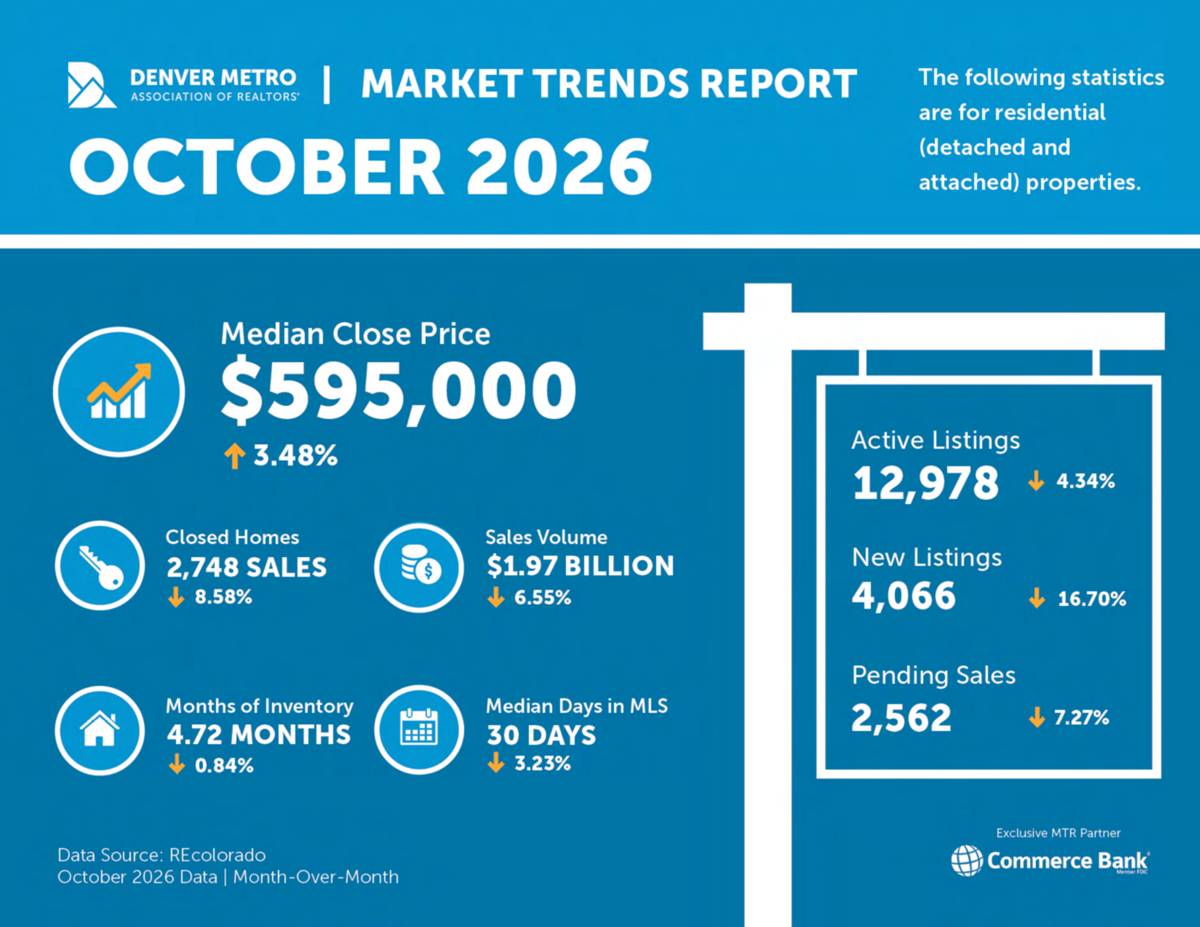
DMAR Market Trends Report, October 2026: Median Close Price, Closed Homes, Sales Volume, Months of Inventory, Median Days in MLS, Active Listings, New Listings, and Pending Sales. Data Source: REcolorado.
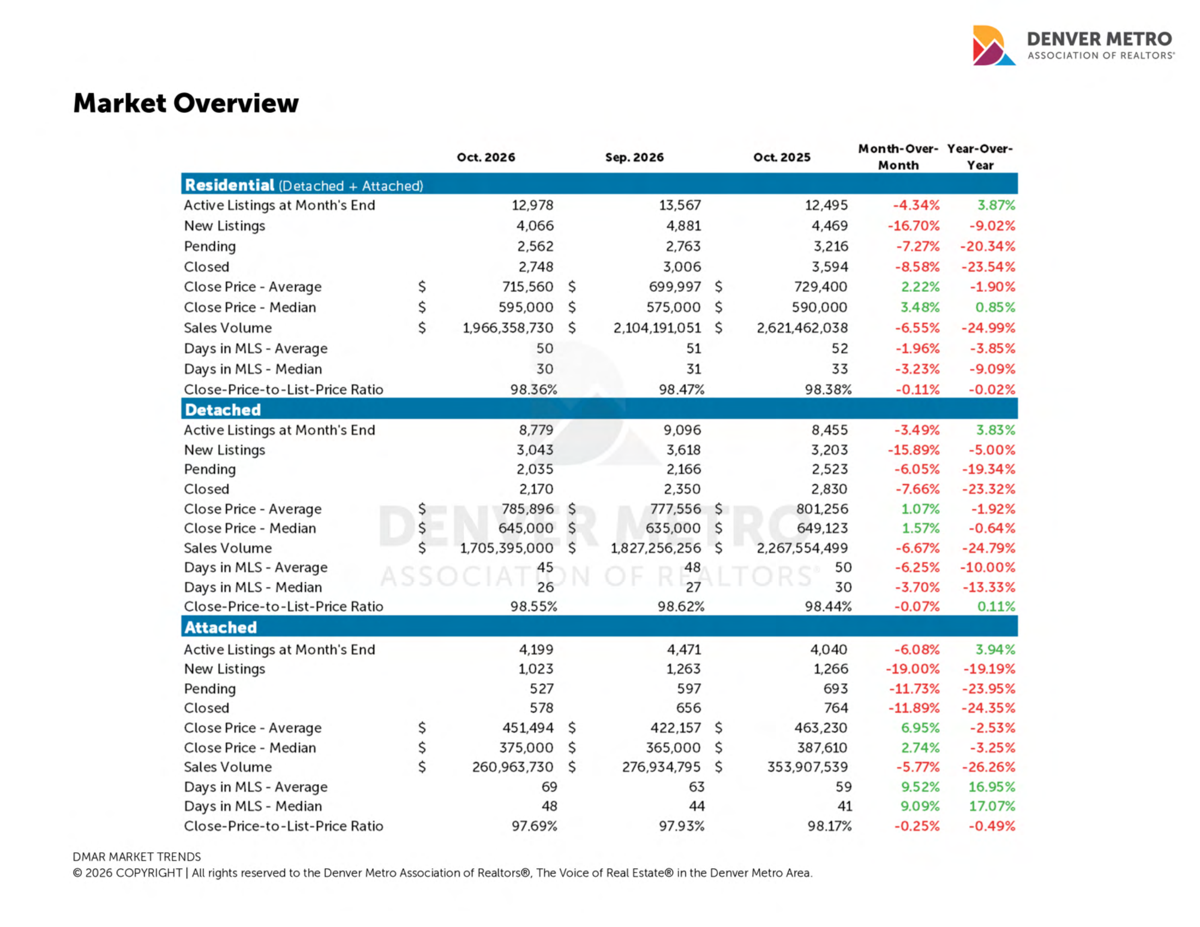
Market Overview: Residential (Detached + Attached), Detached, and Attached, Oct. 2026 vs. Sep. 2026 and Oct. 2025. DMAR Market Trends, October 2026.
Our market has followed historical trends month after month. I built a graph from data I pulled going back to 2009, and it shows prices climbing in the spring. This year, from February to March alone, prices rose 4.2%, roughly $30,000 on an average home.
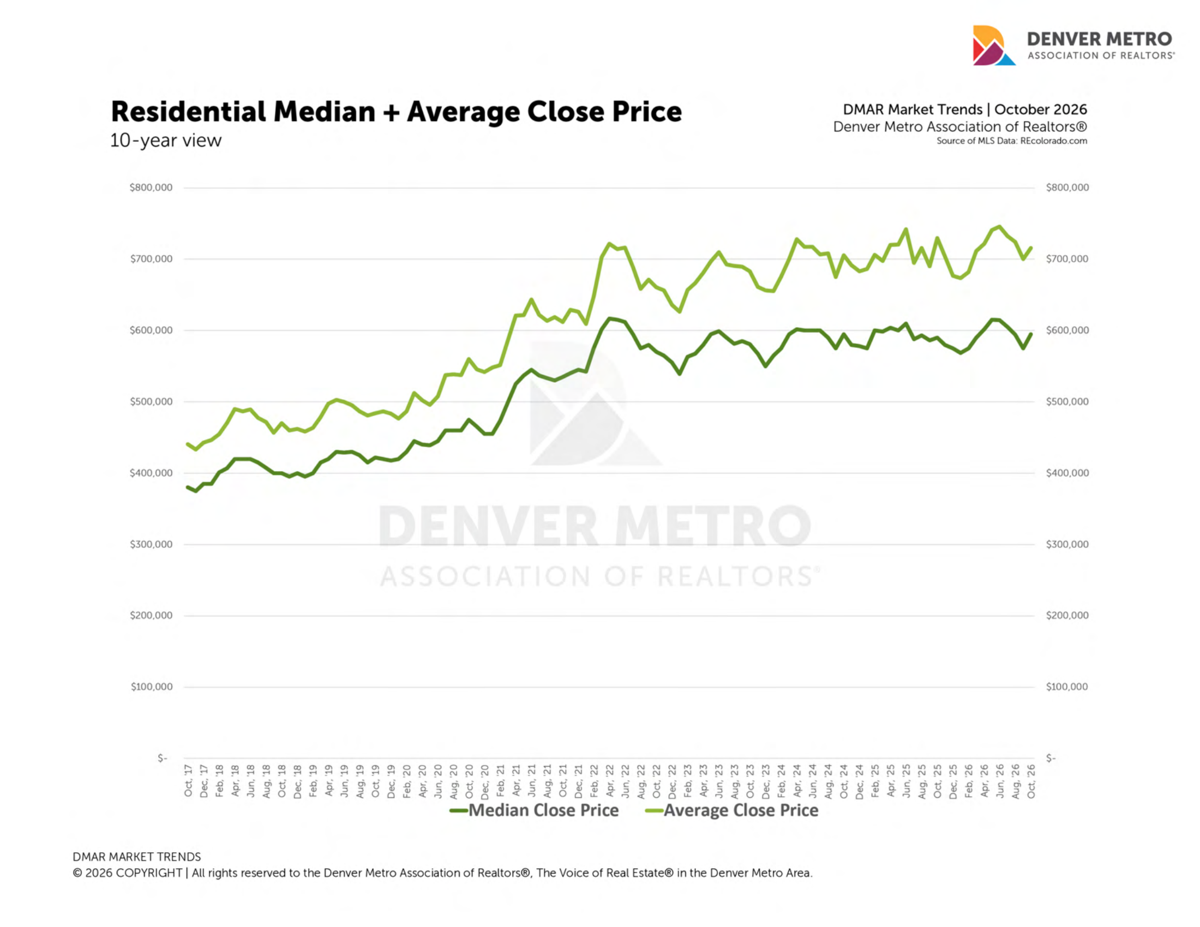
Residential Median + Average Close Price, 10-year view. DMAR Market Trends, October 2026.
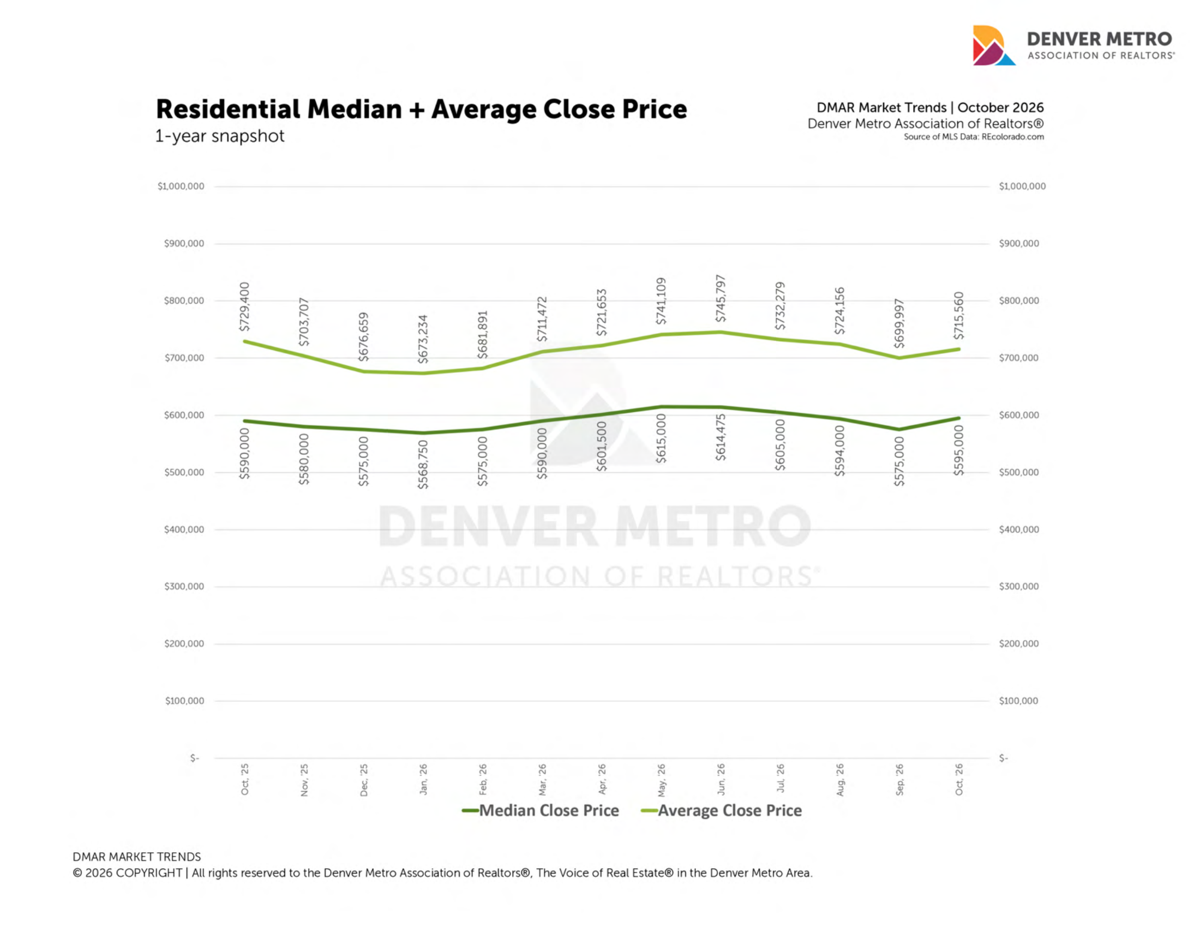
Residential Median + Average Close Price, 1-year snapshot. DMAR Market Trends, October 2026.
2026 started with a big early-spring pickup. Prices were fairly flat in April, and I worried we had seen a very early peak. Buyers came back, though, and May was strong, as it usually is, since many families move in the summer. Prices then pulled back in July, August, and September, the same pattern we have seen for the last 20 years.
Buyers Are Taking Their Time
- Sellers can expect about 14 showings before receiving an offer, and about four showings per month.
- Single-family homes sell in a median of about 28 days, while condos and townhomes take closer to 45.
- Location is still the number one driver of offers. Of my two well-priced listings right now, one got an offer within 10 days; the other, in a less sought-after area, is taking longer.
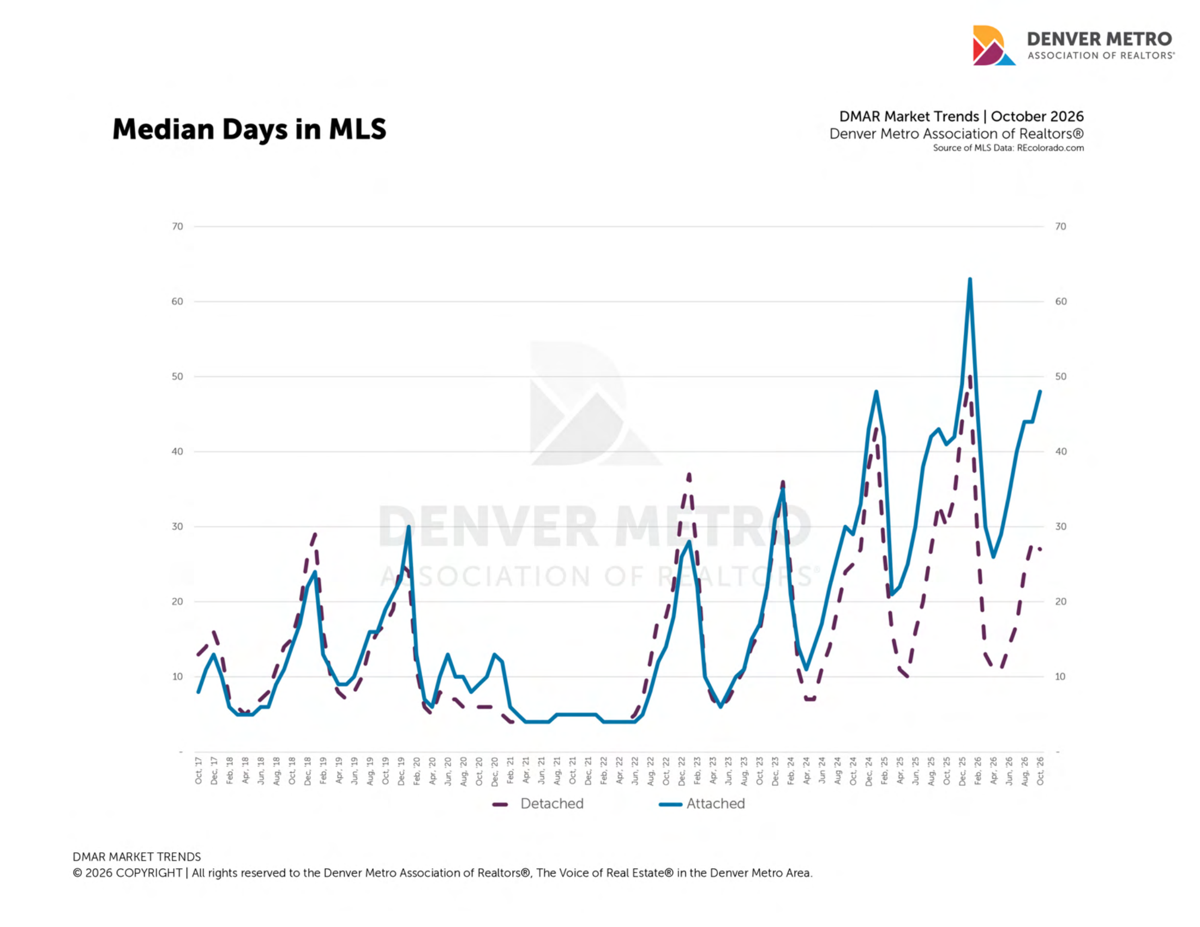
Median Days in MLS: Detached and Attached. DMAR Market Trends, October 2026.
Supply Is Up, Demand Is Steady
We have more listings than we have had in roughly 15 years, since 2012. Some sellers waited with low interest rates and now need to move for personal reasons. Others are testing the market, and withdrawals are up quite a bit, which is part of why we see a pullback late in the year.
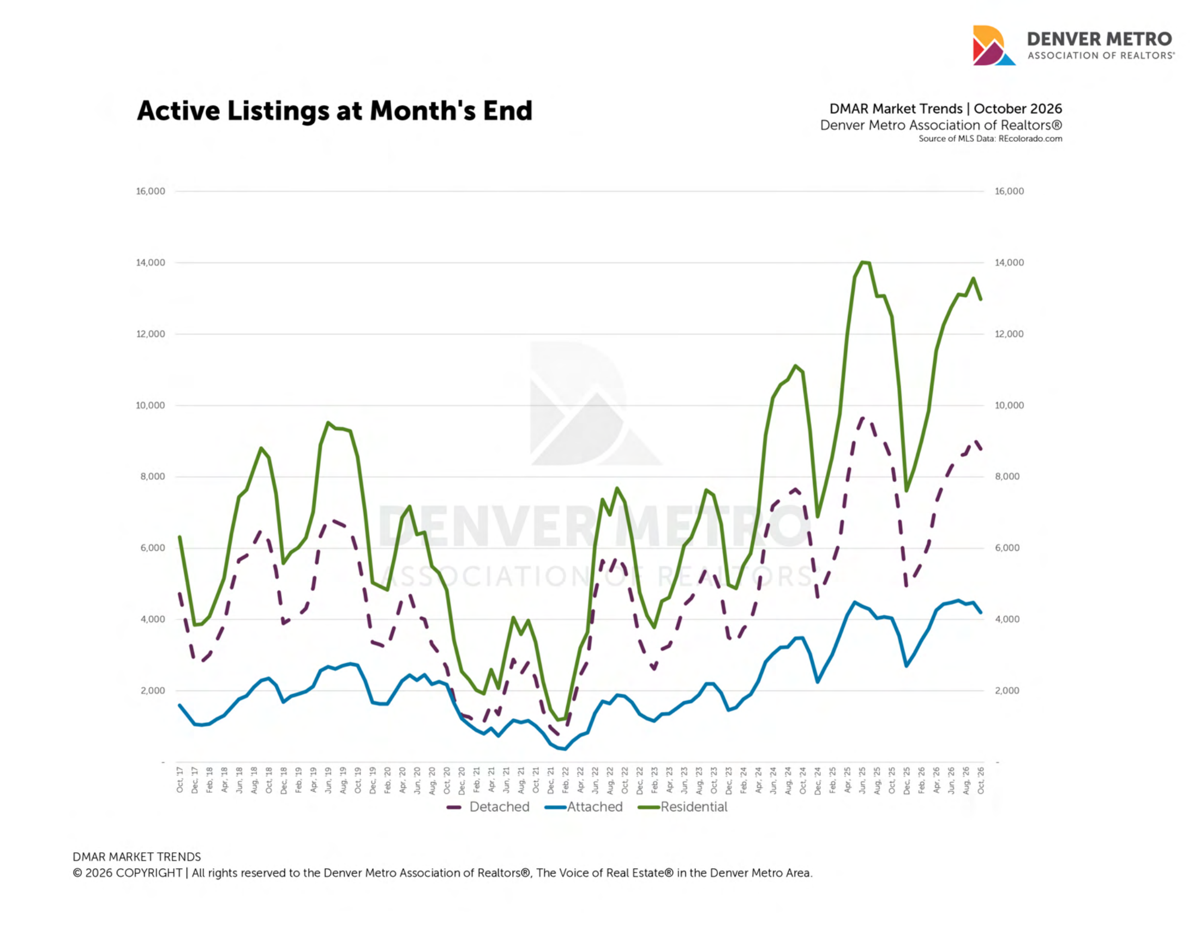
Active Listings at Month's End: Detached, Attached, and Residential. DMAR Market Trends, October 2026.
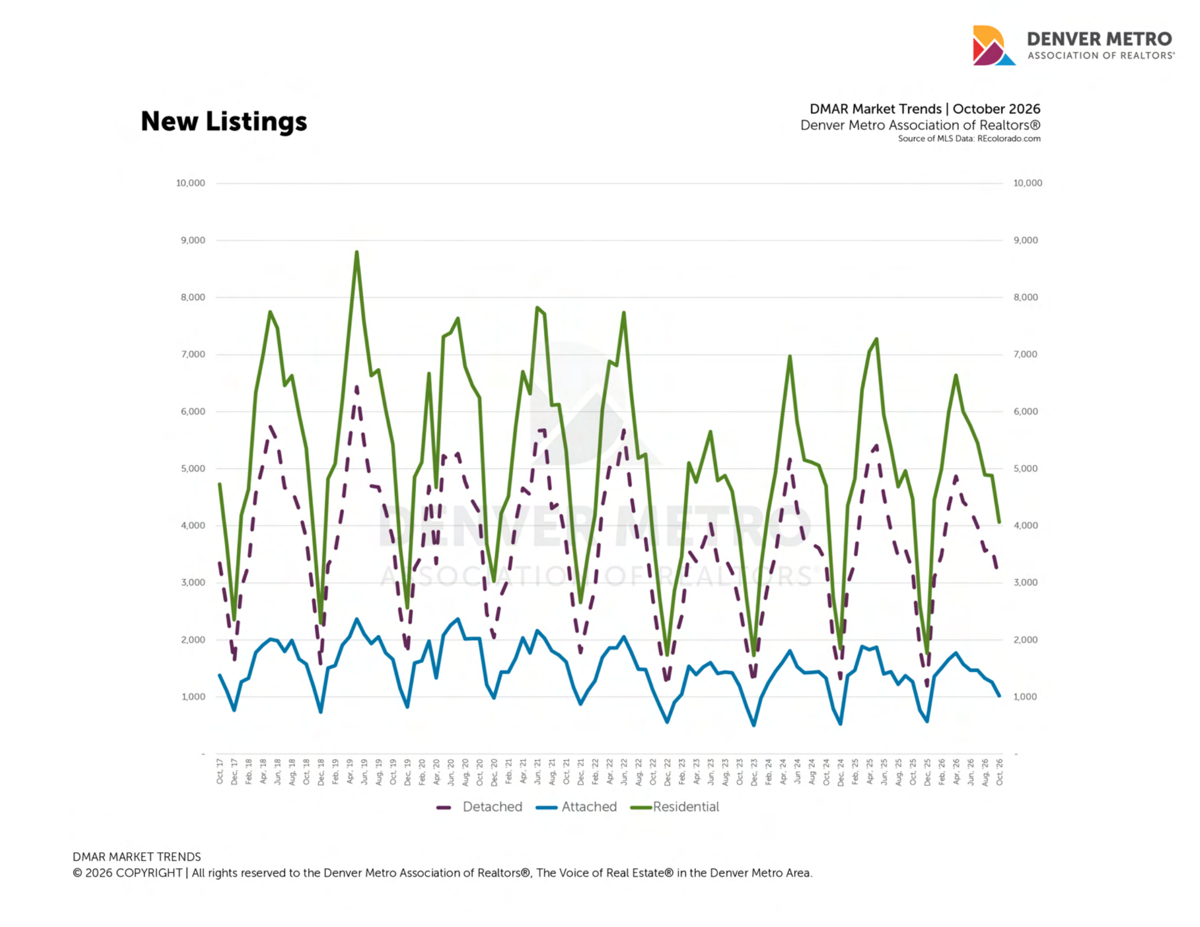
New Listings: Detached, Attached, and Residential. DMAR Market Trends, October 2026.
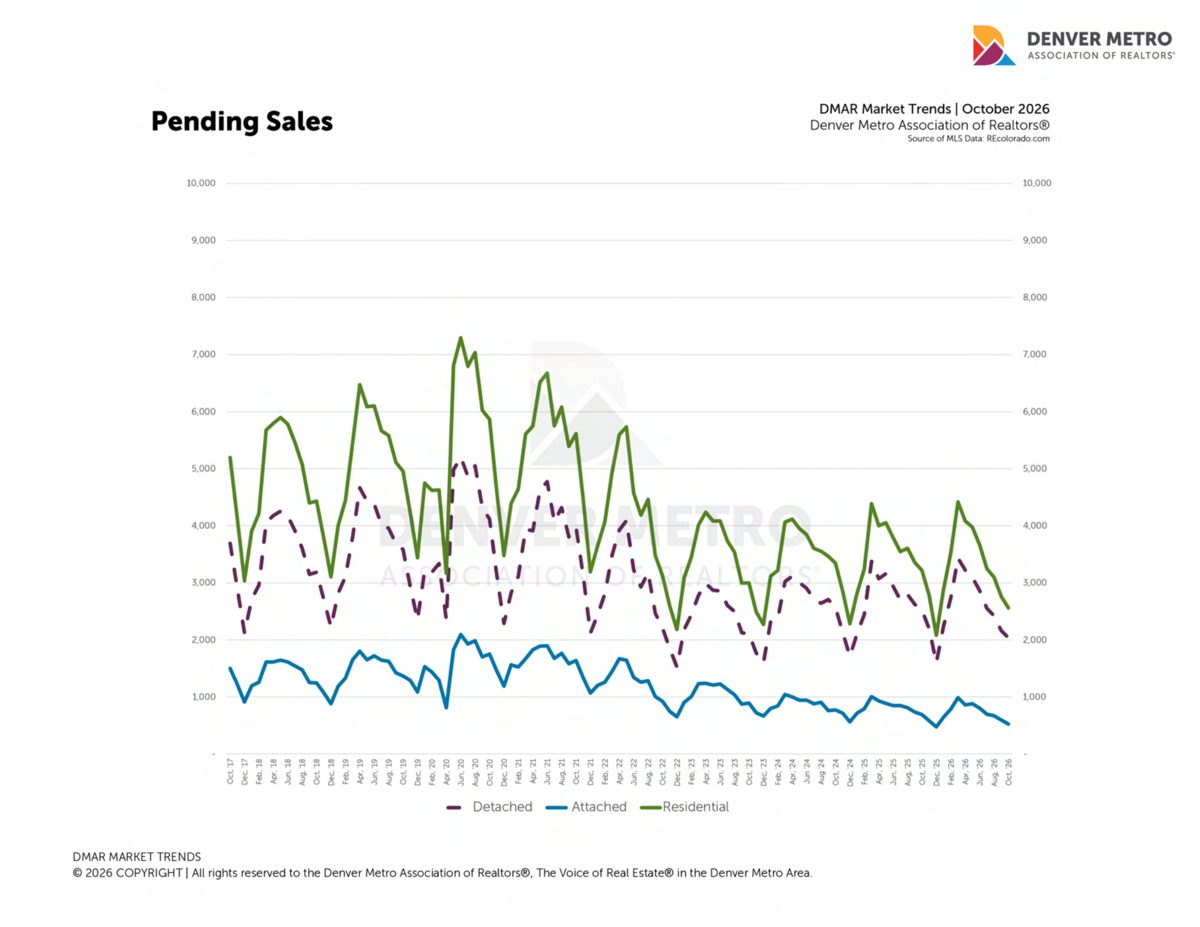
Pending Sales: Detached, Attached, and Residential. DMAR Market Trends, October 2026.
The active and closed sales graph in the DMAR report shows demand looking very similar to past years. My read is that many buyers can afford to buy but are nervous.
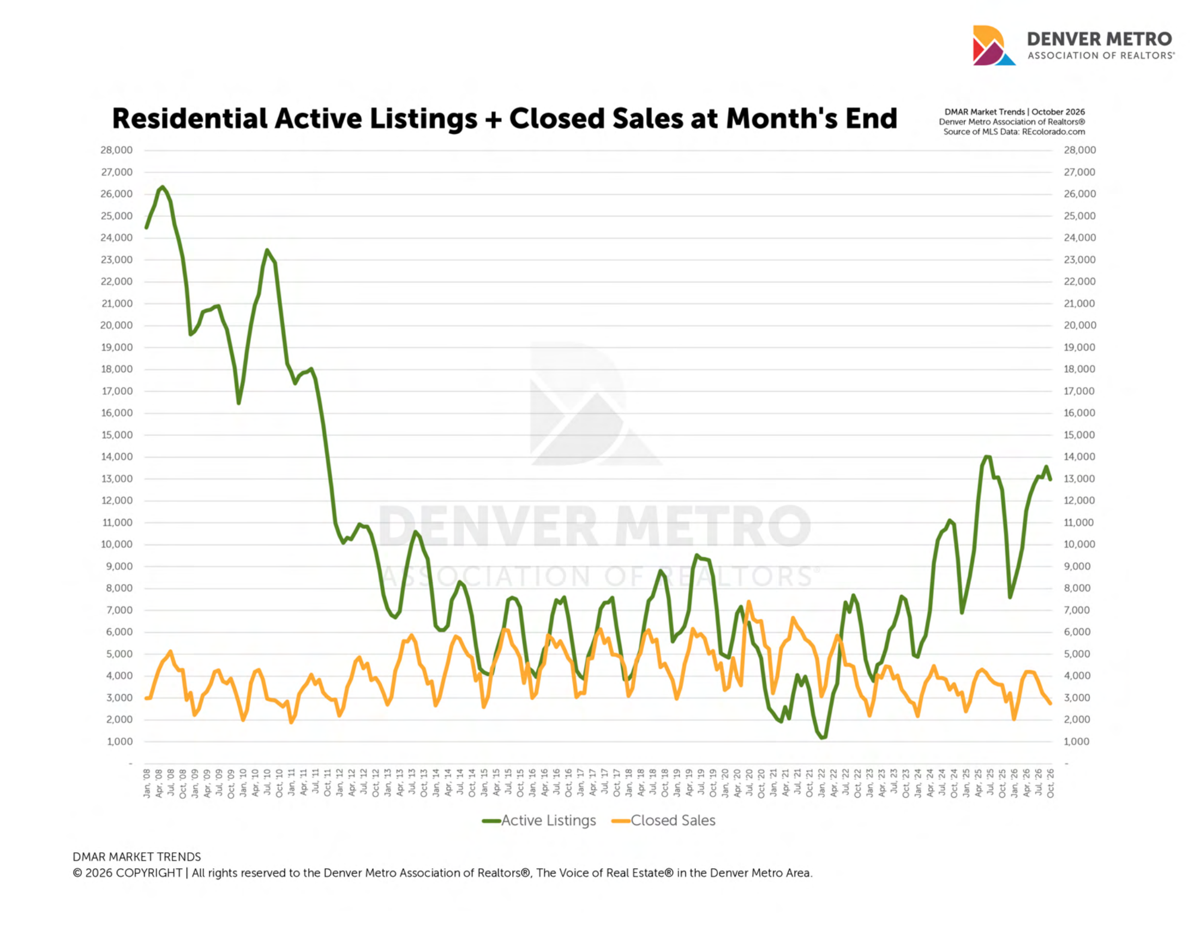
Residential Active Listings + Closed Sales at Month's End. DMAR Market Trends, October 2026.
We Are Still Seeing Appreciation
With supply high and demand soft, you would expect flat prices. Instead, prices are still appreciating.
I am a math teacher, so I ran a true linear regression line of best fit on the average close price. Denver's 50-year average appreciation is around 5 to 6%. If prices had followed that normal trend, they would be higher than they are today; the trend line meets this year's peak. After huge appreciation in the pandemic's low-rate environment, the market has softened and is balancing out.
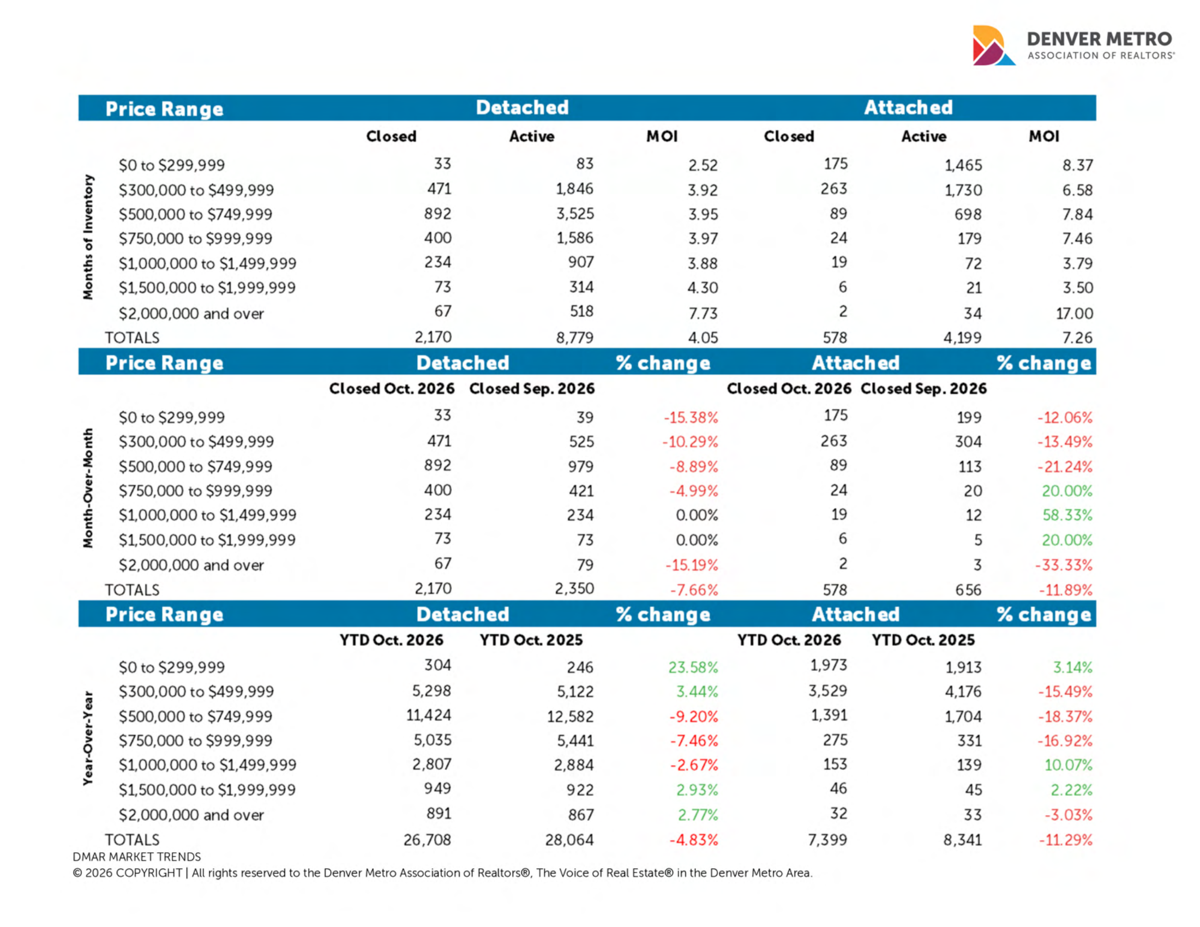
Months of Inventory by Price Range: Detached and Attached. DMAR Market Trends, October 2026.
Three Factors That Will Shape 2027
1. Seasonality, the "New Normal"
This seasonal pattern has played out the same way for the last 4 years, and I believe it is a trend. A couple of years ago, as we moved into higher rates, I coined the term "new normal," and I expect it to continue.
Weather can shift the timing. I believe the early 2026 peak came from beautiful weather; it was around 80 degrees in February. A snowy, El Niño-type year could mean a very quiet winter.
2. AI and Interest Rates
I am automating as much of my business as I can, and I also see the value in our human ability to connect, guide, lead, and care. If AI advances significantly over the next year and unemployment spikes, that could be a problem.
Everyone wants rates to come down, but I am comfortable where they are. Higher rates are softening prices. When rates fall, it is often because the Fed anticipates trouble, usually driven by unemployment. If rates do come down, even into the low 6s, I think we could see a huge spike in buyer activity.
3. Move-Up Buyers
Many homeowners are holding on because they do not want to give up their current rate and possibly double their monthly payment. Move-up buyers usually make up around 25 to 35% of our market. An increase in these buyers, especially young professionals whose careers are taking off, could push prices up significantly. Denver draws many of them.
Why I Believe the Correction Already Happened
During the Great Recession, which was caused by poor lending practices we no longer use, Denver dropped only about 10% peak to trough, while the rest of the country lost about 25%. People who had to sell then lost money, but that is not what is happening now. Foreclosures are at an all-time low, and people who need to sell are selling at reasonable prices or not selling at all.
From 2022 until now, Denver's line has been flat. My prediction is that our correction has already occurred. We have higher rates and a softer market where sellers are willing to negotiate.
What I Expect in 2027
- Sellers will offer concessions to help buyers lower their interest rate, give buyers what they ask for on inspection, and accept a bit less than list price. Buyers who see that opportunity will get the deals.
- Prices will follow the same seasonal pattern: rising January through May, my guess is by about the same 5%, then pulling back in summer, fall, and winter, perhaps with a small pop in September.
- Sellers will likely make the most by selling in April, with a normal 30 to 60 days to sell depending on location and condition. Move-up buyers who are financially ready will make the move and be glad they did.
You Don't Have to Figure This Out Alone
This can be a challenging market, especially if you are buying and selling at the same time, in state or from out of state. Feeling overwhelmed is normal. What you need is a clear, step-by-step plan and someone to brainstorm with.
Read the full DMAR Market Trends Report here
Ready to make a real plan? Book a call with me. I would be honored to help you.
Heather O'Leary